

Insights
What effect do large events have on local economies? Positive, is the usual assumption, with lots of attendees spending money on tickets and on other local goods and services (hotels, travel, food, merchandise, etc.).
For the Office for National Statistics (ONS), one of the challenges of establishing the impact of large events is that they rely on businesses responding to a monthly survey. As one-off events often only account for a small proportion of a business’s activities, especially if the business operates across multiple areas, the impact of the event gets ‘lost’ within the businesses overall position. Addressing this requires more granular data. Recent ONS analysis does just this using anonymised debit and credit card data from Visa to look at the impact of three large events on consumer spending at the local level.
Do large events affect consumer spending?
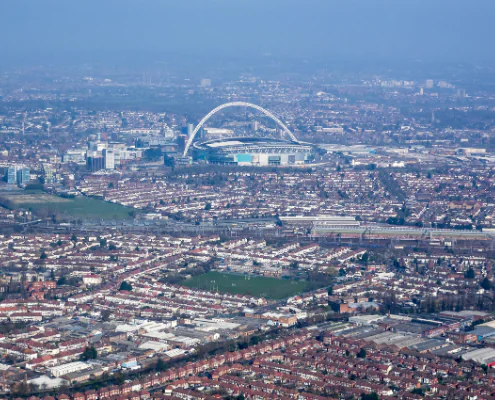
If you are going to look at large events in recent years, what do you pick? If you want headlines and click-throughs, the answer is obvious – Taylor Swift’s 2024 Eras tour. ONS looked at consumer spending in postal districts (EH12, L4, CF10, and HA9) for the stadiums that hosted Taylor Swift concerts – Murrayfield, Anfield, Principality, and Wembley.
They find that the Taylor Swift concerts had limited impact on monthly card spending in these districts. How come? ONS highlight several possibilities. The data may still not be granular enough (and pop-up stalls may be registered elsewhere). Data issues aside, perhaps increased spending on the day of the concert are offset by lower spending on other days. And these stadiums regularly host other large events so perhaps it’s understandable the concerts don’t stand out.
Whilst the overall impacts were limited, the Wembley concerts did see increased spend, particularly for non-UK cards (i.e. spend by international visitors). This mixed picture led to an FT Alphaville article arguing ‘Did Taylor Swift give UK GDP a big boost? Sorry, we still have no idea’.
Findings are similar for the impact of Six Nations Championship rugby matches between 2019 and 2025 (perhaps chosen by some Welsh Rugby fans based in ONS’s Newport offices?). Again, there were no notable fluctuations in monthly spending in Six Nations stadium postal districts during the months matches were played. But there was a large increase in international spend from France and Ireland in the CF10 postal district, home of the Principality Stadium in the months when Wales played those teams.
Thinking more broadly about impacts of large events
ONS’s analysis is interesting but is narrow – focusing on consumer spending near the stadium. Most spend will happen in other locations and at other times. A small number of international booking sites sell tickets months in advance. Travel and hotels, likewise, are booked in advance and most people won’t stay near Wembley or the other stadiums. And anyone staying for more than just the concert is going to spend money – on restaurants, visitor attractions entrance fees, and shopping – in other areas of host cities. Economists refer to this spending elsewhere as a form of leakage.
Even if all of this spend could be captured, economists also worry about displacement. Trips to see Taylor Swift, may be substitutes for visits that would have happened some other time. Some tourists planning to visit the host cities during June and August 2024 may not have come (for example, because hotels were booked or more expensive).
It’s also important to remember that, unlike most business, policymakers don’t really care about spending, other than through the impact on higher-level outcomes such as employment, productivity, and wages. Spending can help but one-off events are unlikely to be largest enough to deliver long run changes in employment and wages. This also means they are unlikely to have additional multiplier effects. Our review of the evaluation evidence on sports and culture interventions confirms this – they often have small, or no measurable effect on employment and wages. New stadiums may be more likely to produce economic benefits than events due to their longevity but their benefits may be capitalised into property rents (creating winners and losers).
What are implications for local areas?
Taylor Swift concerts aren’t a local economic policy (imagine the Outline Business Case) but policymakers often consider funding new stadiums or large events. When thinking about projects of this type, local policymakers should consider whether spend (and other benefits) are likely to accrue to the local area or be distributed more widely, whether the event or stadium will lead to additional economic activity or whether it will displace other activities (with this depending in part on whether it attracts an audience from outside the area), and the distributional impacts of the project. Otherwise, they could choose to ignore these wider economics benefits and focus on enjoying the show.